Insights
Nov 26, 2024
Gamification and AI: A Productive Symbiosis?
Definition of Gamification
Gamification is a concept that integrates playful elements into areas that are usually unrelated to games. The goal is to motivate people and increase their engagement. Gamification can be found in many everyday situations, often without realizing it. By integrating playful elements, tasks that are perceived as boring or monotonous can be made more interesting.
Study "Gamification as a Motivator"
Studies show that gamification not only increases motivation but also improves learning and user engagement. By addressing the natural play drive of people, organizations can encourage behavior change and achieve their goals more effectively.
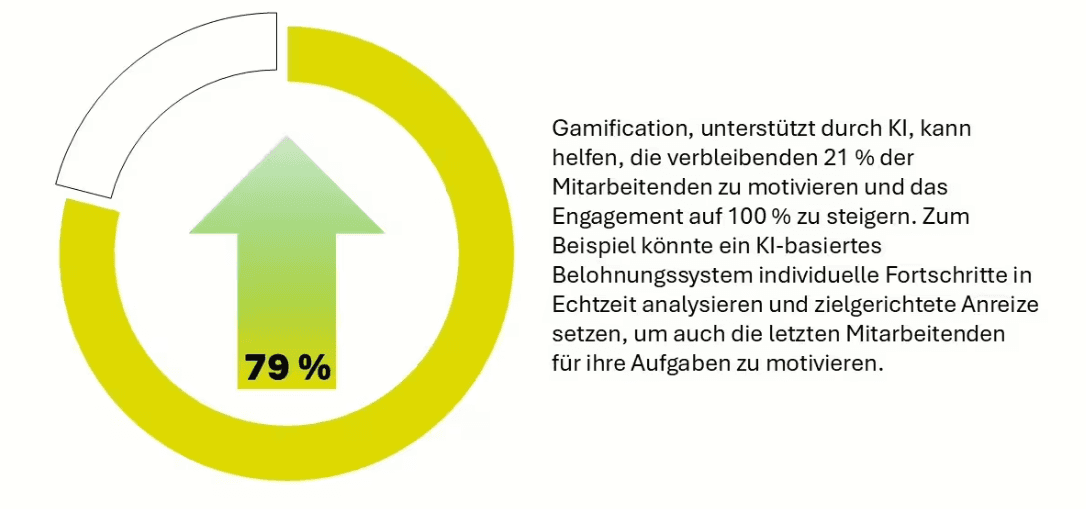
72% of people say that gamification motivates them to complete tasks and put more effort into their work. The symbiosis of gamification and AI creates a completely new approach that not only increases employee engagement but also provides valuable data to continuously improve the system. In this blog post, we will take a closer look at how this symbiosis works and what benefits it offers businesses today.
The Power of Game Mechanics
Gamification, the application of game elements in non-game contexts, has gained enormous importance in recent years. From workplace design to digital transformation – companies increasingly recognize the competitive advantage that well-implemented game mechanics can provide. Gamification, supported by AI, can increase engagement to 100% by setting targeted incentives for the remaining 21% of employees.
Examples from Everyday Life
By integrating point systems, leaderboards, and rewards into everyday work processes, companies can significantly increase employee motivation and engagement. These elements address the human need for recognition and progress and foster a positive work culture. Artificial intelligence increases efficiency and utilizes specific motivation techniques to achieve the best goals.
We know this from the point systems we encounter when refueling, shopping, online shopping, etc. At neuland.ai, we also use gamification in our AI workshops. Our teams are significantly motivated by competitive, playful scoring in the evaluation of potential AI projects. This ensures that each employee aims to achieve a qualitative performance increase on their own. Measuring success through gamification, supported by AI and percentage-based evaluation systems, contributes to improving efficiency and achieving business goals more easily.
Adaptive Learning Environments
AI-driven learning platforms automatically adjust to the individual learning pace and preferences of employees. This not only promotes skill development but also makes further education an interactive and motivating experience.
The Increase of Gamification through AI
Smart Feedback System: AI can provide real-time feedback that goes beyond simple rewards. Based on user behavior, feedback systems can provide additional explanations, incentives, or success tips to promote progress. Use of AI for data-driven analysis: AI can analyze user behavior and preferences and offer personalized playful elements based on that.
For example, a system can recognize whether users are more motivated by competitive challenges, personal goal setting, or small daily rewards. Dynamic Adjustment of Difficulty Levels: Through AI algorithms, the difficulty of tasks can be adjusted based on progress and performance, keeping motivation intact. Similar to a video game, the system adapts to the user's capabilities and consistently offers challenging but achievable goals. Reward Optimization: AI can analyze which rewards or progress elements are most effective and prioritize their use. For instance, a fitness app user who responds well to motivating messages might receive more push notifications with personalized success messages.
Synergies for the Future of (Gamification)
The symbiosis of gamification and AI offers numerous advantages for modern companies: Through personalized goals and immediate feedback, employees can continuously improve their performance. The increase in productivity is evident, and a digital workplace leads to immense performance boosts. The benefit of improved employee retention through gamified systems fosters a sense of belonging and progress, which reduces turnover.
Data-driven Decisions: The combination of gamification and AI provides valuable insights into employee behavior and team dynamics. Employee development becomes more transparent and fosters intrinsic motivation for personal performance enhancement. Organizational structures can be improved through agility. The integration of these technologies promotes a flexible and adaptable corporate culture and supports digital transformation.
Future Trends and Innovations
The future of work will be significantly shaped by the symbiosis between gamification and AI. Some promising trends include:
Virtual Reality (VR) in training: AI-driven, gamified VR environments for realistic learning and simulations. Emotional AI: Systems that recognize and respond to moods and emotions to improve well-being in the workplace. Micro-learning units: AI-curated, gamified learning snacks for continuous skill development in daily work.
Challenges and Solutions
Despite the promising outlook, there are also challenges in integrating AI into gamification concepts:
Data protection and ethics are crucial to highlight. The extensive collection and analysis of data raise privacy concerns. Companies must develop transparent policies and respect employee privacy. Excessive competition can negatively affect team dynamics. It is important to integrate cooperative elements and find a healthy balance. The seamless embedding of artificial intelligence and gamification into existing systems can be technically challenging. Investments in infrastructure and training are often necessary to achieve optimal technology integration.
Conclusion: A Win-Win Situation
The combination of gamification and AI offers enormous potential for increasing productivity, employee satisfaction, and innovative capacity. Companies that skillfully utilize this symbiosis can gain a significant competitive advantage in the rapidly changing digital work environment.
To be successful, organizations must take a holistic approach. This includes considering ethical aspects, promoting an open corporate culture, and continuous change management. Only in this way can the full potential of these transformative technologies be realized. The future of work is playful, intelligent, and above all: human-centered.
Gamification and AI are not just tools, but catalysts for a new era of collaboration and growth in the corporate world. A combination of AI and gamification can create enormous added value as it enables users to have a personalized, motivating, and goal-oriented experience. Through targeted feedback, personalized incentives, fair performance evaluation, and adaptive challenges, motivation can be increased – a true symbiosis of technology and playful engagement!