Insights
Aug 16, 2024
Maximizing Value Creation with AI: A Guide for CEOs
BCG Study: Profit through AI
At a time when AI technologies, particularly Generative AI (GenAI), are making rapid advancements, the transformation of potential into actual profit is the focus. Is profit maximization through value creation with AI possible?
With the right strategic approaches and innovations, it is indeed possible to increase capital value. In today’s digital era, Artificial Intelligence (AI) is at the center of many discussions at executive levels. CEOs are increasingly asking how to derive maximum benefit from AI technologies and maximize business value.
Our extensive experience in implementing Artificial Intelligence (AI) provides practical solutions and strategies that companies can leverage in 2024. These insights are supported by studies from BCG, based on over 1,000 customer projects, as well as forecasts from the Federal Ministry of Education and Research.
Why Now is the Right Time to Invest in AI
The maturity of AI technology has reached a point where it has moved beyond the hype stage and delivers real value. Especially, Generative AI (GenAI) complements Predictive AI and enables companies to operate more efficiently and innovatively in various fields. AI systems are becoming better trained, and AI development is advancing not only through machine learning. Thus, companies that have already taken AI measures are showing impressive results, such as 38% EBIT growth over three years, thus achieving continuous profit maximization (BCG Study).
Three Strategic Approaches to Value Maximization through AI and Efficiency Increase on Top
Deploy (Use of Standard Tools):
The goals are to increase productivity by 10-15%, an improvement in employee satisfaction is always desired, and preparation for broader AI implementations is necessary. For this, CFOs must be won over as advocates of AI applications, a comprehensive AI strategy must be introduced or adjusted. Good examples of implementation include meeting summaries, code development, calendar management, invoice reconciliation, automations, executive and management training, and guidelines.
Internal workshops are very helpful here. Which AI software are you already using, and where do you see a maximization of the value of AI in your company? Reshape (Redesign of Functions) The goals for redesigning are to improve efficiency and effectiveness by 30-50% through workflow optimizations. The readiness for digitalization and optimization of technology must be achieved while always considering AI ethics. Perfect examples can be found in marketing, customer service, design, engineering, and also in communication. In which areas of your company are you already using AI or even planning a redesign?
Invent (Creating New Business Areas)
Here, the goals are to expand revenue sources through new offerings, services, and customer experiences. Value enhancement is achieved through AI research and corresponding AI applications. A neural network is used here in machine learning. Noteworthy examples include hyper-personalized customer experiences, AI-driven services, data monetization, and also data analysis through an AI application. The transformation of value creation and Artificial Intelligence within the company is future-oriented and essential for every management. Starting with an AI workshop to evaluate the right use cases and low-hanging fruits is important. Moreover, the team and the people should be included to ensure the success of such projects. At neuland.ai, we have experienced that implementing projects is up to 80% more efficient when employees are properly engaged and involved from the outset. Further information about our Generative AI Executive Workshop can be found here and everything you need to know about interactive AI workshops.
Which business areas do you see as potentially high?
Success Factors for Implementation towards Value Creation with AI
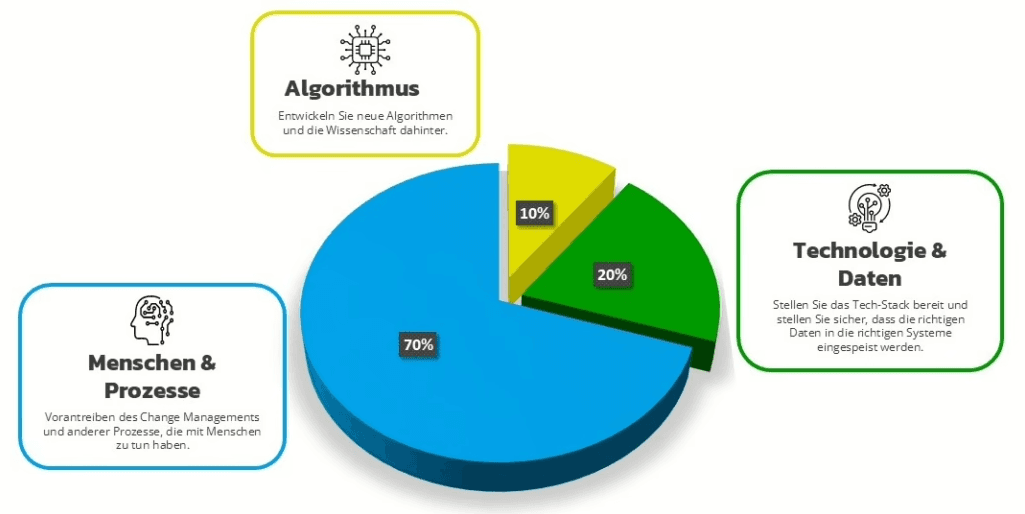
For a successful scaling of AI and its transformation into business success, companies need strong foundations: Talent, technological infrastructure, and a focused approach that concentrates 70% on people and processes, 20% on technology and data, and 10% on algorithms. Maximizing value creation with AI brings a long-term competitive advantage and is achieved through data, talent, and corporate culture.
The Importance of a Fundamental Architecture
In a business world where AI applications become the norm and employees in all areas of the company – from procurement to logistics, service management, call centers, etc. – use AI assistants for a variety of tasks, a robust fundamental architecture is essential. Companies with dozens, hundreds, or even thousands of AI applications in operation need a platform that offers speed, autonomy, and secure results for users, while IT and management maintain control over resources such as roles and permissions, GPU usage, costs, and data.
Decision-makers should ensure that these requirements are met to prevent the emergence of new AI silos and ensure efficient and coordinated use of AI technologies. Imagine you have developed numerous AI applications in parallel in the near future and then need to consolidate costs, computing capacities, and offerings from various systems. This would end in complete chaos. Therefore, it is of utmost importance to establish a comprehensive and controlled architecture from the beginning. Only in this way can it be ensured that all systems are smoothly integrated and management always keeps an overview.
Employee Engagement for Effective AI Solutions
Engaging employees is crucial for developing the right AI solutions and implementing them efficiently. Employees are often the best experts regarding the specific requirements and challenges in their work areas. Through their active involvement, realistic and practical solutions can be developed that increase acceptance and the success of AI initiatives. Additionally, involving the workforce fosters a sense of participation and can enhance the willingness to adapt to new technologies and processes.
Conclusion
In summary, it is essential for companies to establish a solid AI architecture to effectively manage and optimize their AI initiatives. At the same time, employees should be intensively involved in the development process to create practical and accepted solutions. These two aspects are essential to fully leverage the potential of AI technologies and achieve sustainable business success. Furthermore, it is important to ensure a continuous evaluation and adjustment of the deployed AI models to flexibly respond to changing market conditions and technological advances.
The implementation of AI should not be viewed as a one-time project, but as an ongoing process supported by strategic planning and targeted training of the workforce. Ultimately, a company's ability to promote integrated and data-driven decision-making will represent a decisive competitive advantage. By integrating these factors into their AI strategies, companies can not only increase operational efficiency and innovative strength but also secure a leading position in their industry.