Insights
Feb 16, 2025
Quantum AI
"We are on the threshold of a new era of AI – one that far surpasses our current computing capacities."
Karl-Heinz Land
Unprecedented Computing Power with Quantum AI
Artificial intelligence has made remarkable progress in recent years. But what happens when we combine the power of AI with the revolutionary computing power of quantum computers? This fusion could not only increase efficiency but also solve problems that are currently considered insurmountable.
What is Quantum AI?
Quantum AI (Quantum Artificial Intelligence, QAI) in German Quantum AI describes the combination of quantum computing with modern AI technologies, particularly in the fields of machine learning, neural networks, and language models (LLMs). While quantum computing has often been seen as a vision for the future, AI has quickly established itself as an indispensable tool for business and research. But why is quantum computing suddenly relevant for AI?
The Growing Relevance of Quantum Computing for AI
Current AI systems are reaching their capacity limits: High energy demands, slow processing, and immense computing requirements prevent widespread scaling. This is particularly evident in language models that rely on increasingly larger datasets and more complex parameters. For instance, it is suspected that the GPT-4 model has over 1.76 trillion parameters – a number that is becoming increasingly difficult to manage with conventional supercomputers.
Quantum AI offers new solutions here. By utilizing quantum mechanics, it can perform computations in parallel, significantly increasing speed and efficiency. Quantum AI algorithms can process and learn from vast amounts of data exponentially faster. As a result, future AI models could be more powerful and simultaneously more resource-efficient. Another crucial advantage is the ability to solve complex problems. While classical computers hit their limits, quantum AI can tackle challenges previously deemed unsolvable – for example, in optimization, materials science, or drug discovery. Additionally, quantum AI enhances data security.
Quantum encryption algorithms allow the creation of virtually unbreakable codes, which is particularly important for protecting sensitive information in AI systems. With this new infrastructure, the next generation of AI models could become not only faster but also safer and more scalable. A pivotal point here is the interface between classical and quantum AI, created by tensor technology and specialized software. This technology allows existing systems to be connected with the fundamental principles of quantum computing without requiring fully functional quantum computers.
Thus, Quantum AI is already relevant today, as it creates efficiencies and new opportunities for data-intensive processes, even if the widespread use of quantum computers is still in the future. neuland.ai is engaged with Quantum AI because the combination of tensor technology, quantum algorithms, and domain-specific software enables a new generation of scalable AI solutions. However, to understand the potential of Quantum AI, it is worth looking at the technological foundations.
The Technological Foundations
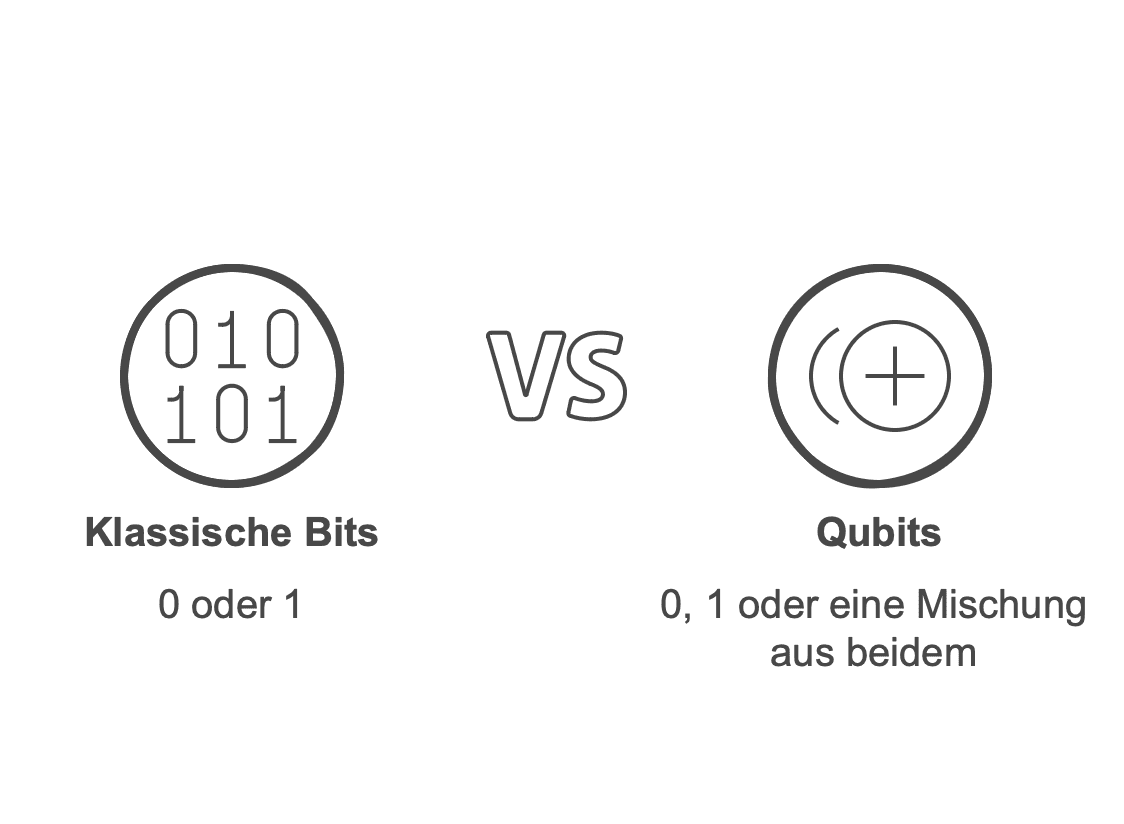
Classical computers use bits, which are encoded as 0 or 1, and work sequentially to process data. Quantum computers, on the other hand, use qubits, which can contain additional information due to the state of superposition, meaning they can be 0, 1, or a mixture of both. This is complemented by the principle of entanglement, which enables communication between qubits at unprecedented speeds. This allows for parallel calculations and exponentially higher efficiency. Whereas classical computers painstakingly process each computation step, quantum computers can solve complex problems, such as prime factorization, in no time.
This forms the basis for the revolutionary computing power of Quantum AI. Although fully functional quantum computers are not yet widely available, new approaches are already relying on hybrid models.
Quantum algorithms are initially simulated on classical supercomputers, targeted at subproblems, and then integrated into classical systems. This means that even without fully-fledged quantum computers, significant improvements can already be achieved. In practice, selected subproblems are solved using quantum methods, and the results are integrated into classical systems, leading to an overall improved computing power: More efficient simulations: Especially in chemistry and materials science, complex molecular designs can be simulated faster and more accurately. Improved optimization: Applications in logistics planning or portfolio optimization benefit from the power of quantum algorithms. Reduction of training data: In machine learning, quantum AI can work with less data and still deliver fast results.
What Opportunities Does the Future Hold?
Many brokers rely on automation to optimize trading portfolios, but as the complexity of strategies increases, classical AI reaches its limits. Quantum AI could bring about a change here, as it recognizes patterns in vast datasets and enables precise predictions based on them.
This could lead to innovative trading platforms that replicate successful portfolios and dynamically optimize investments. Another field of application is logistics, particularly in route optimization. Traditional systems struggle when numerous variables such as traffic, fuel consumption, and time windows need to be considered. Quantum AI enables these factors to be analyzed simultaneously. This leads to a reduction in CO2 emissions, the minimization of empty trips, and cost savings. Global logistics companies could make their supply chains more efficient using quantum algorithms. Quantum computers are ideally suited to model the highly complex processes of the natural world, which could significantly improve weather forecasting and climate predictions. Quantum AI could also achieve significant breakthroughs in climate research – from analyzing the effectiveness of CO2 reduction measures to developing innovative green technologies.
Challenges in Implementation
Currently, quantum computers are in an early development phase, and only a few research institutions and companies have access to this technology.
This complicates the development and testing of quantum algorithms. For example, chemical simulations that theoretically have high potential could only be practically realized with widely available hardware. Another issue is the development of scalable quantum algorithms. Many existing approaches work well in isolated scenarios or on a small scale, but hit their limits when employed in more complex applications. Integrating into existing IT systems also presents a significant challenge. Companies must not only invest in new hardware but also adapt their software to use quantum algorithms. This requires significant financial resources and the retraining of IT teams. Hybrid approaches that combine classical and quantum-based components may offer initial solutions but are often fraught with compatibility issues.
Finally, the comprehensibility of the technology remains an important point. Quantum AI is a highly complex field, and its benefits are often difficult to communicate. To achieve broader acceptance, practical examples and tangible scenarios must be created.
Conclusion
The implementation of Quantum AI presents challenges, but at the same time opens new dimensions for data-intensive applications. Especially in areas with enormous computing demands – from materials research to optimizing industrial processes – Quantum AI holds the potential to solve problems that would be nearly insurmountable for classical computers. For instance, a task that would take 5,000 years on conventional computers could be completed in just a few minutes with a quantum computer.
This flexibility and speed illustrate the potential, particularly in optimizing industrial processes. This insight into this emerging complex advancement of AI offers a very important acknowledgment for companies: The so-called "trap of simplicity" is an often-overlooked factor: What seems uncomplicated at first glance proves to be extremely challenging in implementation.
Many companies that underestimate the challenges realize too late that AI is more than a simple application like ChatGPT. It requires standardization and clear standards – ideally from established players with robust expertise. Moreover, it is becoming increasingly clear that successful AI applications require a solid architecture and secure, reliable, and legally compliant solutions. To meet these demands, we at neuland.ai have developed innovative approaches, including our Enterprise AI platform and Industry Domain Models. These tools help companies address their specific requirements and integrate AI applications efficiently into their processes. The combination of advanced technologies such as quantum computing, tensor technologies, and knowledge graphs opens up new possibilities, while expertise in practical implementation ensures that projects do not fail due to the "trap of simplicity." It remains an exciting field that is still truly uncharted territory for many companies.