Insights
Service automation: Benefits for businesses
The Potential of Service Automation
In an increasingly digitized world, service automation is becoming a central factor for companies looking to strengthen their competitive edge and improve their service quality.
But how often have we asked ourselves: Can we make routine tasks more efficient to focus resources on innovation and growth? By employing modern technology, especially Artificial Intelligence (AI), companies can not only reduce costs but also elevate the customer experience to a whole new level. But what exactly is behind this term, and what benefits does service automation actually bring?
What is Service Automation?
Service automation refers to the targeted use of technologies to reduce manual tasks, make processes more efficient, and focus on strategic goals. In customer service and beyond, it not only increases efficiency but also enhances the flexibility and transparency of processes. Let’s imagine a complex machine system: each individual component plays a role, but only through precise coordination does efficient operation emerge. The same is true for service automation – technologies such as data analysis and AI work seamlessly together to achieve optimal results.
A Concrete Example: Automating Car Search
A car dealership could use a virtual assistant not only to facilitate the search for the perfect vehicle, but also to retain customers long-term. For instance: A customer is looking for a specific vehicle that is currently unavailable. The assistant remembers the request – including specific wishes – and searches the entire internet live and 24/7. Such continuous searching would be virtually impossible for a human. Weeks later, the desired vehicle becomes available. While a staff member may have forgotten this customer, the assistant proactively suggests informing the customer, thus fulfilling wishes faster and more reliably. This efficiency demonstrates how AI solutions can sustainably optimize processes. The result: The customer feels valued and gets the impression of being individually cared for. Simultaneously, employees save time and find items that were previously outside their search radius because they can focus on more complex requests. The assistant is not just a helper, but a strategic partner in the sales process.
Automation Meets Personalization
The possibilities are versatile:
Initial Consultation: The assistant asks about budget, equipment wishes, and vehicle types.
Dynamic Suggestions: With each interaction, it learns and improves the quality of results.
Long-Term Customer Support: Proactive reminders of customer wishes or upcoming maintenance. Such assistants not only provide added value for customers but also strengthen the role of employees. They only step in when genuine expertise is needed – allowing them to focus specifically on their core tasks.
Cold Calls: Individual Approach Instead of Call Center
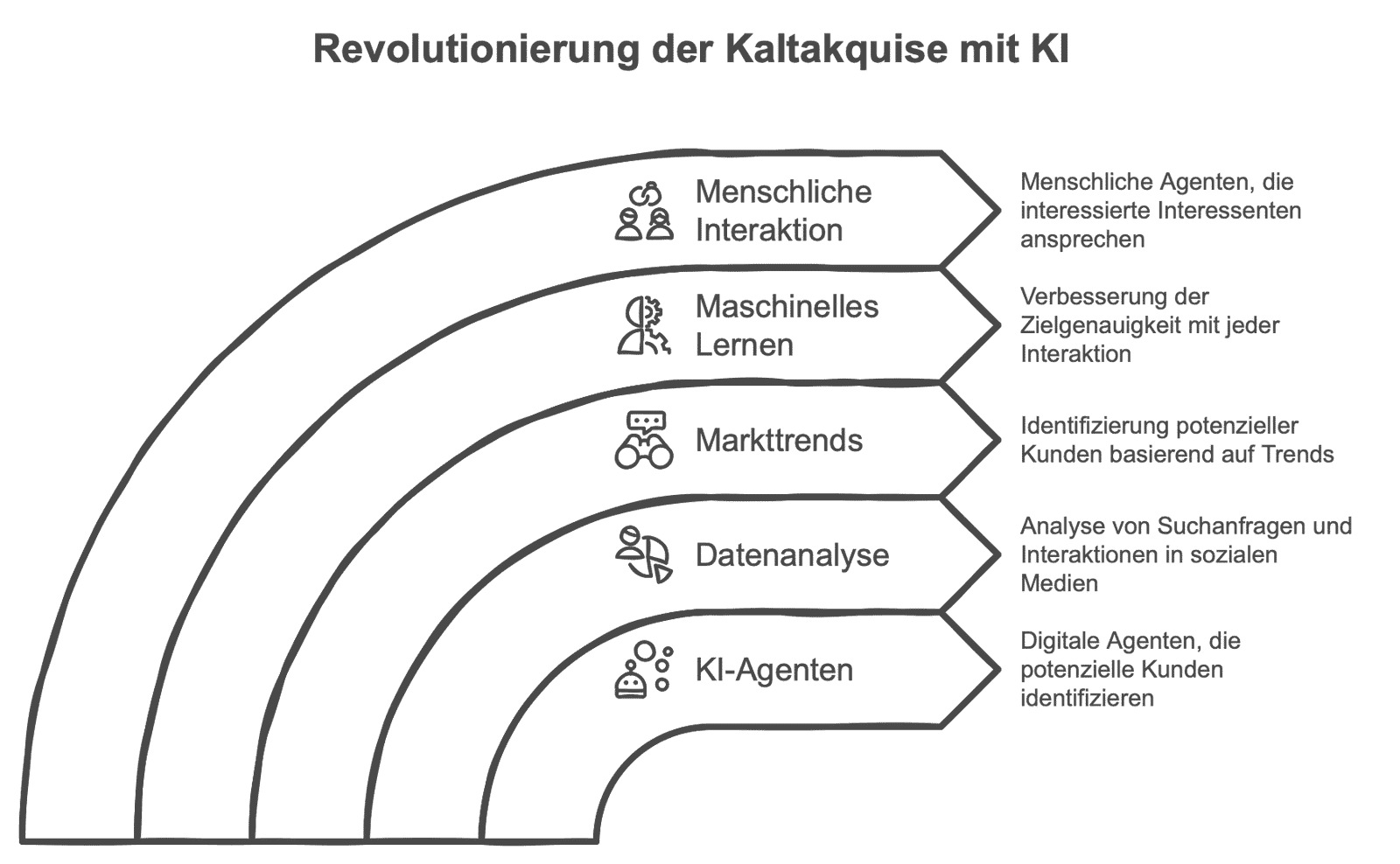
Another area where proactive AI services shine is in cold calling. Traditionally, cold calling has been associated with high costs and often low success rates – a call center calls a large number of potential customers, hoping to reach a few interested parties. But with AI-powered agents, this inefficient method is a thing of the past. Imagine a digital agent that identifies potential customers based on data and market trends.
This agent analyzes search queries, social media interactions, and other data points to locate individuals who might be interested in a particular product or service. Instead of a faceless mass approach, there is now an individualized outreach tailored to the customer's needs.
The catch: The agent continuously improves its skills through machine learning. With each interaction, it enhances its ability to find and approach suitable customers. Once a prospect shows clear signals, a human employee takes over to deepen the conversation. This combination of automation and human sensitivity maximizes efficiency and significantly increases the success rate.
Customer Service as the Key to Customer Loyalty
Customer service is the cornerstone of successful business relationships. It encompasses all measures aimed at recognizing and fulfilling customers' wishes and needs – from individual consultation to quick problem resolution. In the past, customer service was a personal experience, characterized by closeness and trust, as in the classic corner store. With industrialization, it became standardized, often impersonal, and shifted into call centers or service hotlines.
However, today’s customers expect personalized, quick, and straightforward solutions – around the clock. Thanks to modern technologies like AI and data analysis, companies can operate more efficiently and respond better to individual needs. Examples include automated product recommendations or proactive services that offer solutions before a problem arises. Moreover, customer experience has emerged as a key competitive advantage. In markets with interchangeable products, customers often choose based on service quality, determining which company they prefer in the long term. In short: Customer service is much more than a department. It is the key to customer loyalty and a central factor in the competition of the digitized world.
Proactive Services: A New Standard in Customer Service
Proactive services address this very point. They ensure that customers are not just satisfied but delighted. With the help of AI and automation, companies can identify early when a customer needs support. For instance, an online retailer could notify a customer that a frequently purchased item is about to run out, or a car manufacturer might send a notification that a maintenance appointment is due. This kind of customer service is more than just a solution – it shows the customer that they are at the center of attention. It is a shift from reactive to proactive support enabled by digitization. Companies that utilize proactive services create a unique customer experience that strengthens not just satisfaction but also loyalty.
How Does AI Affect Telecommunications?
In telecommunications, AI has revolutionized service automation. Imagine a customer interacting with a chatbot that not only answers questions but also creates personalized offers based on previous interactions. These chatbots, supported by advanced data analysis, provide seamless support. Furthermore, network operators leverage AI to analyze traffic in real time and anticipate potential problems. Such systems generate forecasts that not only enhance network stability but also improve customer experience. Telecommunications impressively shows us how automation changes the way companies serve their customers.
Technologies Driving Service Automation
The development of service automation is based on a combination of modern technologies that together usher in a new era of efficiency and innovation. But how do these technologies function in practice? Artificial Intelligence (AI) forms the foundation for adaptive systems that become more precise with each interaction. Data analysis helps companies gain deeper insights into customer behavior and offer tailored solutions. Automation platforms integrate various business areas, facilitating resource optimization. Cloud technology provides the necessary flexibility and security to operate automated systems efficiently. Technological trends like machine learning enhance the accuracy and ability to automate processes.
Change Management: The Key to Successful Implementation
Despite the impressive benefits, implementing service automation requires targeted change management. Transitioning existing operations and integrating new technologies can initially meet resistance – especially when employees are not involved early on. Training and clear communication are essential to foster acceptance within the team and successfully implement automation. A structured change management approach allows companies to master the challenges of implementation and benefit from the advantages in the long run. It is also important to pay attention to the quality of the underlying data to ensure the transparency and accuracy of automated systems.
Market Trends and Future Perspectives
The future perspective of service automation indicates that we are already in an exciting transformation phase today. Thousands of specialized AI assistants will take on various tasks in the future, elevating service to a completely new level. What seems unimaginable to many is already a reality: AI assistants communicate with each other and rely on each other to provide the best results. Each AI assistant has its own individual strength and optimally combines this in the network.
An assistant could focus solely on generating offers, while others simultaneously research the cheapest products or analyze market trends. This networking creates a harmonious interplay that revolutionizes efficiency and precision in service design. Technologies like IoT, 5G, and advanced self-learning systems drive this development. They enable companies to respond agilely to new market conditions and offer personalized, scalable services. These trends not only open up higher efficiency but also create entirely new business models characterized by agility and innovation. The future is connected – and it begins now.
Conclusion: Growth and Innovation Through Service Automation
Service automation is much more than a tool for increasing efficiency – it is a driver of innovation and sustainable growth potential. Companies that implement these technologies early and execute solid change management secure a clear competitive advantage. The question is no longer whether automation makes sense, but how companies can optimally use it to shape their future. Are you ready to discover the potentials of service automation? Tip for the reader: Feel free to delve deeper into AI assistants and where the difference between assistants and chatbots lies.